Blog
How AI Ecommerce Search Works
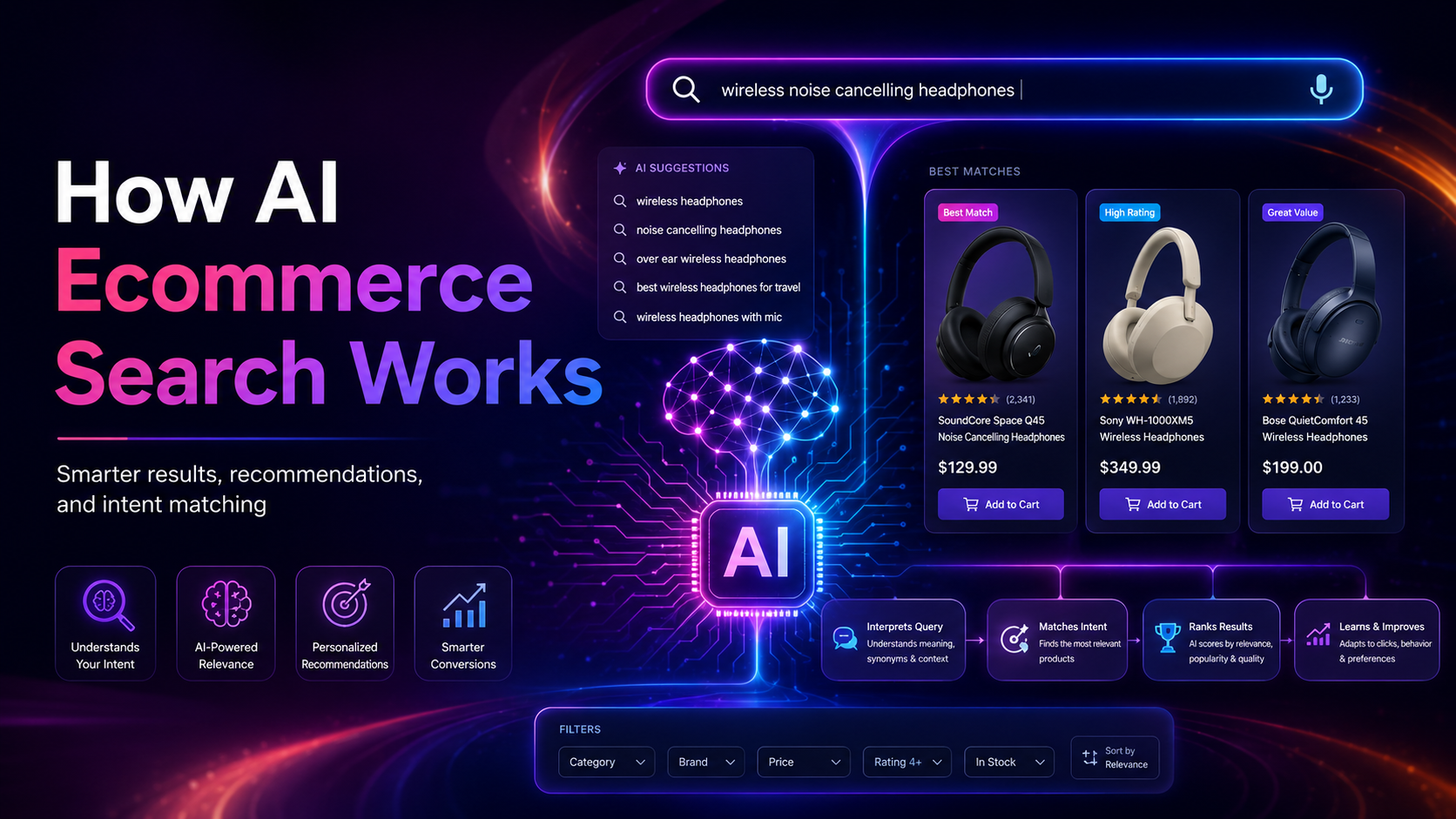
What Is AI Search for Ecommerce?
AI search for ecommerce refers to search technology that uses machine-learning and natural-language processing techniques to understand what a shopper means — not just what they literally typed. A traditional keyword search engine treats a query as a bag of words to match against a product database. An AI-powered engine treats a query as an expression of intent and tries to satisfy that intent even when the words used are imprecise, abbreviated, or misspelled.
The practical difference is significant. Type "blk jns slim" into a keyword engine and you will likely get zero results. Type the same thing into a well-tuned AI search engine and you will see a page of slim-fit black jeans, because the system has learned to bridge the gap between how people write and how products are described.
The Core Technologies Behind AI Ecommerce Search
Modern AI-powered search engines combine several techniques, and it is useful to understand each one separately.
Typo Tolerance and Fuzzy Matching
The simplest form of "AI" in search is fuzzy matching — the ability to return results even when the query contains spelling errors. A fuzzy matching algorithm calculates the edit distance between a typed word and words in the index: how many insertions, deletions, or substitutions would it take to transform one into the other?
A search engine with good typo tolerance will match "trainers" when someone types "trainers", "trianers", or "trainres", without manual effort from the store owner. This alone has a measurable impact on no-results rates.
Synonym and Concept Expansion
Products are described in catalogues using specific language, but shoppers use their own vocabulary. "Sofa" and "couch" mean the same thing. "Jumper" and "sweater" mean the same thing in different parts of the English-speaking world. An AI search engine can be configured with synonym rules so that querying one term automatically expands to include the other.
More advanced systems infer semantic relationships from the structure of the product catalogue itself, learning that certain terms co-occur with certain product types. Both approaches improve recall — the proportion of relevant products that appear in results — without sacrificing precision.
Natural Language Query Understanding
When a shopper types a longer phrase like "men's waterproof hiking boots under £100", a keyword engine will try to match every word independently. A natural-language system parses the phrase as a structured query: product type "hiking boots", gender "men's", material attribute "waterproof", price constraint "under £100". This kind of query decomposition produces much more accurate results pages.
Intelligent Ranking
Getting the right products into the results set is half the battle; ranking them correctly is the other half. AI ranking systems weigh multiple signals simultaneously:
- Text relevance — how closely does the product title, description, and attributes match the query?
- Popularity signals — products that are frequently clicked and purchased for similar queries rank higher.
- Business rules — featured products, high-margin items, or in-stock products can be boosted by the store owner without overriding the relevance model entirely.
- Stock status — out-of-stock products are typically demoted to avoid frustrating shoppers with items they cannot buy.
The combination of these signals, weighted and balanced by a machine-learning model, produces a ranking that serves both the shopper and the business.
How AI Search Handles Indexing
For AI search to work at sub-50ms speeds, the heavy processing cannot happen at query time. Instead, it happens at index time — when products are ingested into the search engine's data structure.
During indexing, the engine processes every product: normalising text, extracting attributes, building the inverted index that maps terms to product IDs, and pre-computing data structures that enable fast fuzzy matching and filtering. This pre-computation is what allows results to return in milliseconds rather than seconds.
When you add a new product or update a price, the connector syncs that change to the index in near real-time, so your search results always reflect your current catalogue. For WooCommerce stores, the WooCommerce search connector handles this sync automatically. For Shopify stores, the Shopify app does the same.
SKU, Attribute, and Variation Indexing
One of the most important practical aspects of AI ecommerce search is how it handles product variants. A single WooCommerce or Shopify product might have dozens of variations — different sizes, colours, and materials, each with its own SKU. If someone searches for a specific SKU or a specific variation ("blue XL polo shirt"), they expect to land on the right product with the right variant pre-selected.
A well-built AI search engine indexes each variation's attributes and SKUs separately, so these specific queries resolve correctly instead of returning a generic product page that requires additional navigation.
What AI Search Cannot Do (Yet)
It is important to be honest about current limitations. AI search in 2026 is excellent at understanding natural-language queries, handling typos, expanding synonyms, and ranking intelligently. It does not — at the platform level — deliver visual search (searching by image upload) or fully personalised per-shopper rankings based on individual browsing history. Those capabilities exist in enterprise solutions at enterprise price points.
What AI search does deliver at scale is a dramatically better experience than default keyword matching: faster, more forgiving, more intelligent, and more useful to the motivated buyer.
The Analytics Layer
AI search produces valuable data. Every query, every click, every abandoned search tells you something about your shoppers and your catalogue.
The most actionable analytics output is the no-results report: a list of queries that returned zero products. This list tells you directly where your synonym rules, product naming, or catalogue coverage are failing. Acting on it — adding synonyms, adjusting product titles, filling gaps — is one of the highest-return SEO and merchandising activities available to a store owner.
See How to Reduce No-Results Searches in Your Store for a practical guide to this workflow.
Getting AI Search on Your Store
Search Sight's AI-powered search delivers all of the capabilities described here: typo tolerance, synonym expansion, natural-language query handling, intelligent ranking, and a no-results analytics report — on a five-minute setup timeline. All features are included on every plan.
Start your free 14-day trial and see what AI search for ecommerce looks like on your own catalogue.
For a broader introduction to how all the pieces fit together, visit the ecommerce search hub.