Blog
Semantic Search vs Keyword Search for Ecommerce
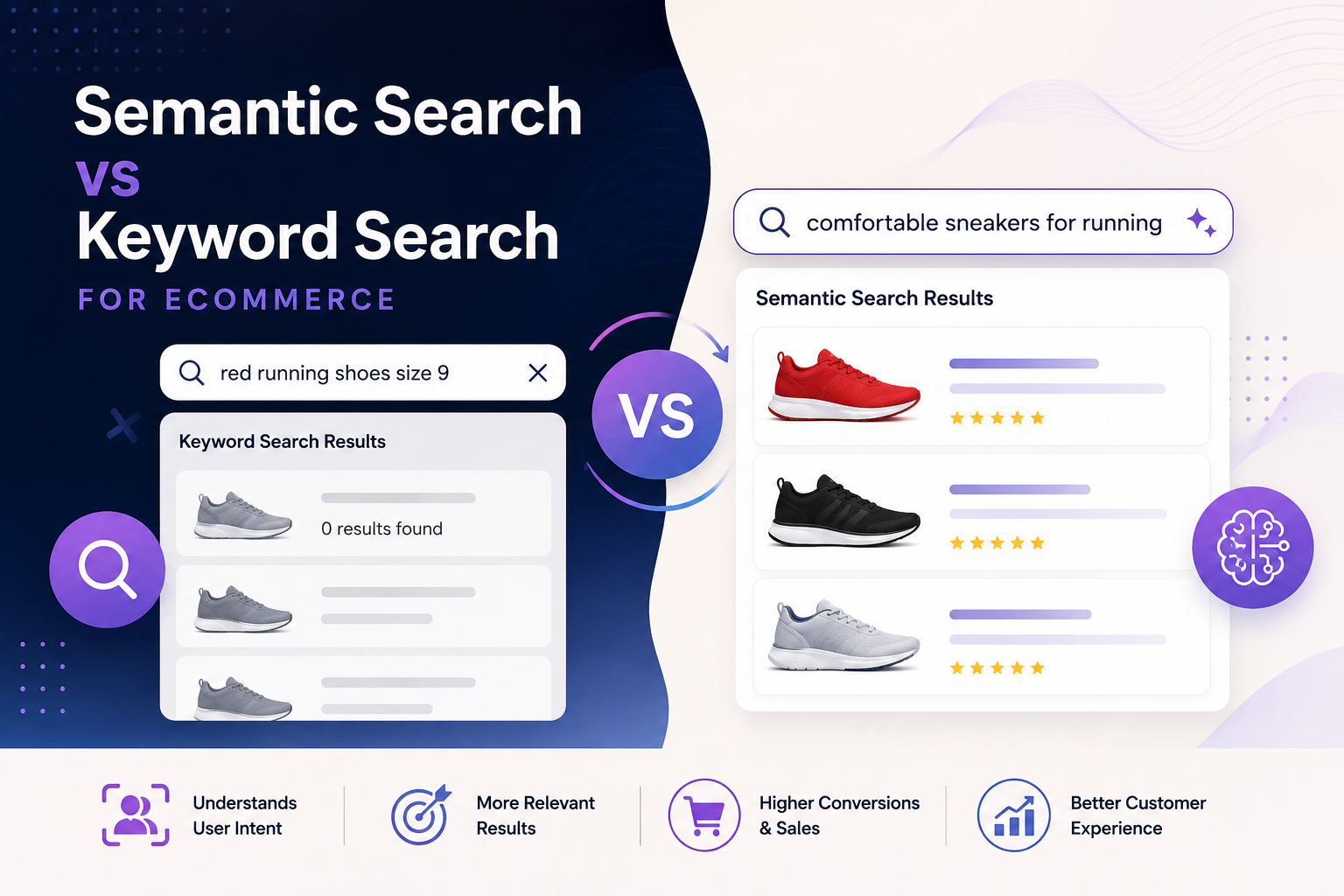
What Is the Difference Between Semantic Search and Keyword Search?
Semantic search and keyword search represent two fundamentally different approaches to matching a query to a result. Understanding the distinction is increasingly important for ecommerce store owners, because the approach your search engine uses shapes how well it handles real shopper queries.
Keyword search works by matching the literal words in a query to the literal words in your product records. A query for "leather bag" matches products that contain the words "leather" and "bag" in their indexed fields. The engine does not know that "leather" and "suede" are both materials, or that "bag" and "tote" are related concepts — it only knows whether those specific character strings appear in the product data.
Semantic search works by understanding the meaning behind the words. A semantic engine knows that "running shoes" and "jogging trainers" describe the same category of product. It understands that "lightweight" and "breathable" are attributes that often co-occur for certain product types. It can surface a relevant result even when the query does not share a single word with the product title.
How Keyword Search Works in Practice
Classic keyword search engines use an inverted index: a pre-built lookup table that maps every word in the catalogue to every product that contains it. When a query arrives, the engine looks up each query word in the index, finds the matching product IDs, and returns the intersection.
This approach is fast and predictable. It also has well-known limitations:
- It fails on synonyms unless manually configured.
- It fails on abbreviations and informal language.
- It fails on attribute-based queries where the attribute value is not literally in the product text.
- It returns nothing for queries with no exact lexical overlap with any product record.
For ecommerce catalogues, these limitations manifest as a no-results rate that is significantly higher than it needs to be, and a results page that often surfaces less relevant products above more relevant ones.
How Semantic Search Works in Practice
Semantic search engines encode words and phrases as mathematical vectors — essentially, coordinates in a high-dimensional space where similar concepts are clustered near each other. "Running shoes" and "jogging trainers" end up close together in this vector space, so a query for one retrieves results close to both.
This approach is powerful for understanding intent, handling paraphrases, and bridging the language gap between how catalogues are written and how shoppers speak.
In a pure form, semantic vector search has its own limitations. It can be slower than keyword search. It sometimes retrieves semantically related but contextually wrong results — a query for "air pump" might surface "air freshener" because both contain "air" and both are common household items, even though they are completely different product types.
The most effective modern search engines combine both approaches, using keyword matching for precision and semantic understanding for recall and intent interpretation.
The Hybrid Approach: Best of Both
In practice, the best ecommerce search engines in 2026 use a hybrid architecture. Keyword matching handles exact product titles, SKUs, brand names, and specific attribute queries with high precision. Semantic or AI-enhanced processing handles natural language queries, synonym expansion, and intent interpretation.
This combination addresses the core limitations of each approach in isolation:
- Keyword matching alone fails on synonym and language variation.
- Pure semantic matching alone can produce confusing results for exact queries like brand names or specific model numbers.
- Together, they handle both the precise query ("Nike Air Max 90 size 9") and the natural-language query ("comfy everyday trainers under £80") correctly.
Search Sight's AI-powered search uses this kind of hybrid processing, combining a fast indexed keyword layer with AI-enhanced query understanding to handle the full range of real ecommerce queries. For more on how the AI layer works, see How AI Ecommerce Search Works.
Why This Matters for Your Store's Conversion Rate
The practical commercial impact of semantic versus keyword search comes down to two metrics: the no-results rate and results relevance.
A store running pure keyword search will have a no-results rate that reflects every terminology gap between its catalogue language and its shoppers' language. Every informal query, every regional variant, every abbreviation that does not appear verbatim in a product record returns nothing. The no-results page is a near-certain bounce.
A store with semantic or AI-enhanced search handles these gaps automatically. The engine understands that "couch" and "sofa" are equivalent. It understands that "cheap running shoes" is asking for price-conscious relevance, not just products that contain the word "cheap". It surfaces the right products for a much higher proportion of real-world queries.
The results relevance impact is more subtle but equally important. Even when keyword search returns results, the ranking is often suboptimal because it is driven by term frequency rather than genuine product-query relevance. Semantic ranking, weighted against actual product data and attribute structure, tends to put the right products first more consistently.
Should You Care About the Underlying Technology?
For a store owner, the key question is not "does my search engine use TF-IDF or vector embeddings?" — it is "does my search engine handle real shopper queries well?" The technology is a means to an end.
The practical tests for your current search:
- Search for a product using a synonym your catalogue does not use. Do you get results?
- Search using informal or abbreviated language. Do you get relevant results?
- Make a deliberate typo. Do you get results?
- Run a broad natural-language query. Are the top results actually the best matches?
If the answers are no, no, no, and not always, your store would benefit from an AI-enhanced search engine regardless of the underlying technology label. The ecommerce search hub is a good starting point for understanding what modern search looks like in practice.
For the WooCommerce-specific implementation, see WooCommerce search. For Shopify, see Shopify search.
Start your free 14-day trial to see the difference semantic-enhanced search makes on your own product catalogue.