Blog
Ecommerce Site Search Statistics That Matter in 2026
Why Ecommerce Site Search Statistics Matter
Numbers alone do not run a store, but ecommerce site search statistics help frame decisions. When you understand how search-using shoppers behave differently from non-searching ones — and what a poor search experience costs — you can make a much stronger case for investing in search improvement, whether that is to yourself, a business partner, or a board.
This piece collects and contextualises the most important patterns and observations about ecommerce site search performance. Where we cite figures, they are illustrative industry observations drawn from patterns widely reported across the sector, not fabricated precision data. The directional truth of these patterns is well established even when specific numbers vary across sources, sectors, and store sizes.
Search Users Are Disproportionately Valuable
Perhaps the most consistently reported finding in ecommerce site search research is that shoppers who use the search function convert at meaningfully higher rates than those who browse. This is not surprising — a shopper who uses the search bar has already signalled intent. They know what they want and are actively looking for it.
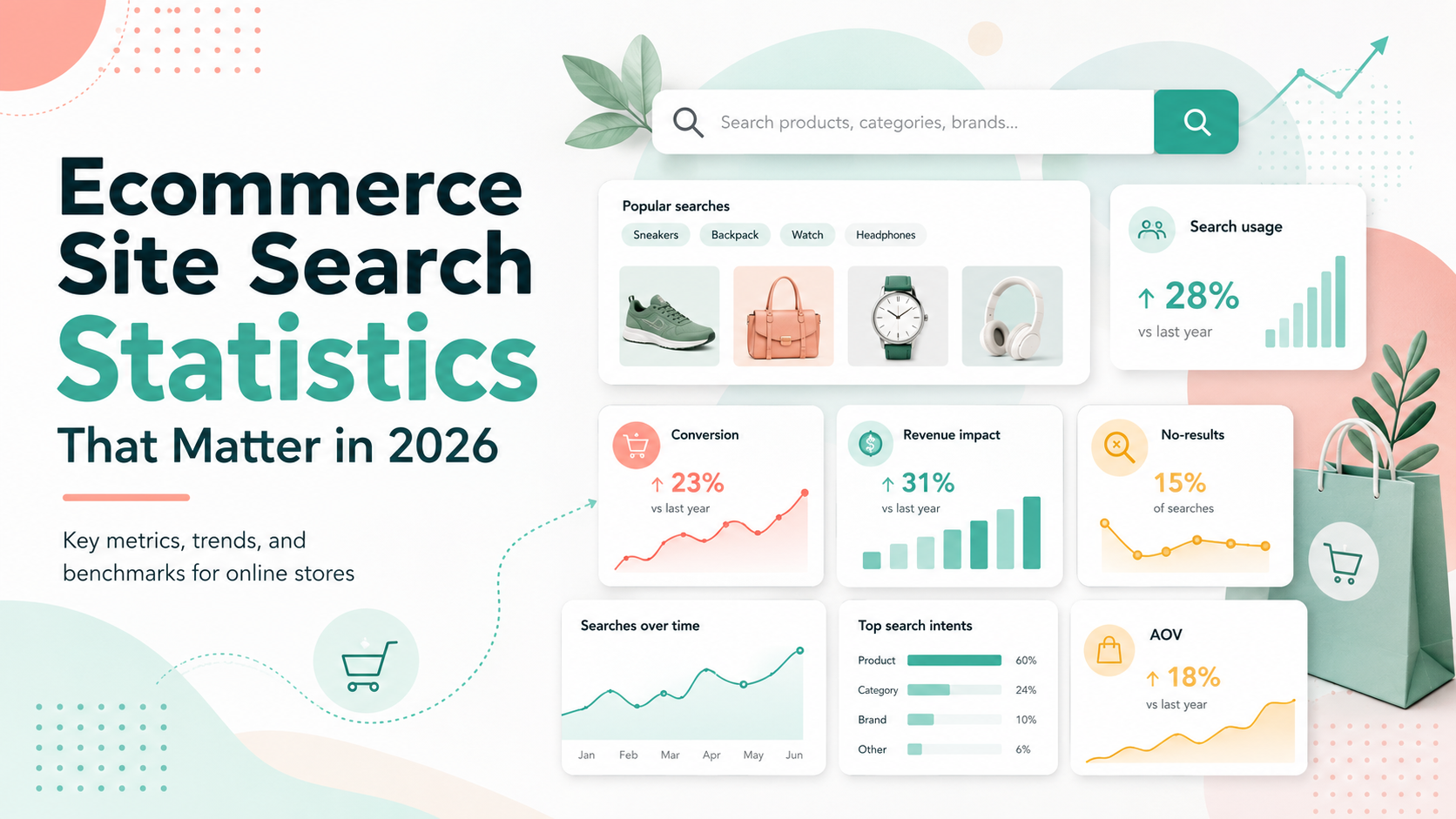
The conversion rate differential between search users and non-search users is widely observed to be in the range of two to three times across ecommerce broadly. The exact ratio varies significantly by sector, catalogue size, and the quality of the search implementation — a poor search experience narrows the gap — but the direction is consistent across every study and analysis we are aware of.
This figure has a practical implication: search users, despite often being a minority of total sessions, can represent a majority of revenue on stores with large catalogues. Improving their experience has a disproportionate impact on the bottom line.
Average Order Value Tends to Be Higher Among Searchers
Beyond conversion rate, search users tend to spend more per order. The most commonly cited driver is query specificity: a shopper who searches for "cashmere rollneck jumper in navy" is looking for a specific, often premium, item. They are less likely to be browsing for the cheapest option and more likely to buy when they find exactly what they want.
Studies across apparel, home goods, and electronics consistently find that average order values for search sessions are higher than for browse sessions. The differential is typically in the range of 10-25%, though this varies by vertical.
The No-Results Rate Is a Direct Revenue Leak
Industry observations suggest that between 15% and 30% of on-site searches return no results on stores using default platform search, with the rate often higher for stores with large or attribute-rich catalogues. Every zero-results page is a near-certain bounce — the shopper has nowhere to go except away.
On stores with dedicated search engines, properly configured with typo tolerance and synonyms, the no-results rate typically falls to the low single digits. The difference between a 25% no-results rate and a 3% no-results rate, on a store with meaningful search traffic, represents a significant number of recoverable sessions.
For the practical approach to reducing this rate, see How to Reduce No-Results Searches in Your Store.
Shoppers Expect Sub-Second Search Responses
Response time expectations for site search have shortened considerably as shoppers have been conditioned by major retailers and Google's instant search. Research into perceived response time consistently shows that delays above 200ms are noticeable, and delays above 500ms begin to create frustration.
For autocomplete specifically, the bar is even higher: a dropdown that does not appear until after a perceptible pause disrupts the typing rhythm and feels broken. The sub-50ms standard for autocomplete response times is not arbitrary — it is the threshold at which the experience feels genuinely instant rather than merely fast.
Mobile Is Where Search Matters Most
A majority of ecommerce traffic now originates from mobile devices, and the share continues to grow. On mobile, the navigation limitations are more pronounced: small screens, limited visible product grid, and the physical awkwardness of scrolling through hundreds of results make search the most efficient discovery path.
Mobile shoppers who use search are particularly valuable because they have overcome the friction of typing on a mobile keyboard — a signal of high motivation. The mobile no-results rate tends to be higher than desktop because of greater typing imprecision, which makes mobile-ready typo tolerance even more important.
Shoppers Who Cannot Find a Product Do Not Always Ask for Help
One of the more sobering observations in ecommerce UX research is that shoppers who reach a no-results page typically do not scroll down, click related product links, or contact customer support. They leave. The bounce rate from no-results pages is consistently reported as one of the highest of any page type on an ecommerce site.
This means that a no-results event is not a soft failure with a second chance — it is, in most cases, a lost customer. The product was probably in the catalogue; the search engine just failed to find it.
Search Analytics Are Underused
Despite the availability of search analytics in most platforms, many store owners do not review their search data regularly. In surveys of ecommerce operators, the most commonly cited reason is that the data is hard to access or interpret in default analytics setups.
Dedicated search platforms make this data significantly more accessible. A no-results report that shows you the top failing queries in plain language, sorted by frequency, converts an abstract problem into a specific to-do list. Stores that review and act on this data tend to see continuous improvement in their no-results rate over time.
For the full context on how search drives ecommerce performance, see Ecommerce Site Search Best Practices and the ecommerce search hub.
For a side-by-side comparison of search solutions, visit the compare page.
Start your free 14-day trial and start generating search analytics data for your own store.