Blog
Search Relevance and Ranking, Explained
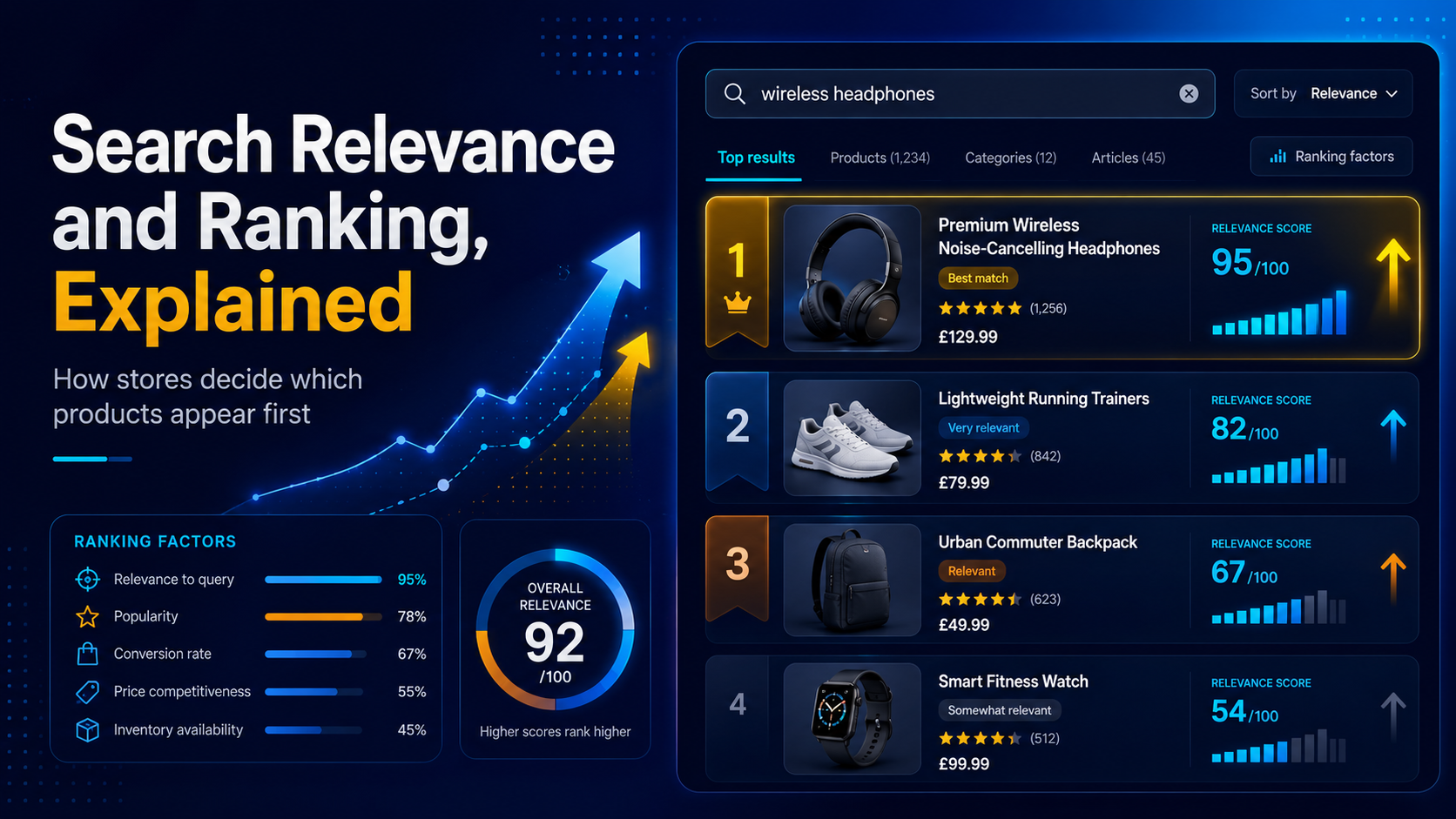
What Is Search Relevance?
Search relevance is the measure of how well the results returned by a search engine match the intent behind a query. A highly relevant result is one that the searcher wanted to find; an irrelevant result is one that technically matches keywords but does not serve the searcher's actual need.
In ecommerce, search relevance has an immediate commercial dimension. A search engine that consistently ranks the most relevant products first converts more searchers into buyers. One that ranks poorly — even if it avoids no-results pages — loses sales by burying the right products behind tangentially related ones.
Understanding how relevance is calculated, and how it can be improved, is valuable for any store owner who wants to get more out of their search investment.
How Search Engines Calculate Relevance
At the core of almost every search engine's relevance model is a comparison between the query and the document — in this case, the product record. The engine asks: how well does this product description match what the shopper asked for?
Several factors feed into this calculation.
Field weighting. Not all parts of a product record are equally important. A match in the product title is a stronger signal of relevance than a match buried in the product description. A match in the primary attribute (colour, material) is more significant than a match in metadata. Search engines apply different weights to different fields, so a title match scores more than a description match.
Term frequency and placement. A query term that appears multiple times in a product record, or appears early in the title, is treated as a stronger relevance signal than one that appears once at the end of a long description.
Edit distance / typo penalty. When typo tolerance kicks in, the relevance score is typically penalised slightly for approximate matches. An exact match on "boots" scores higher than a fuzzy match for "boos". This ensures that exact matches appear above approximate ones in the ranking.
Attribute completeness. Products with rich, complete attribute data — full colour options, all sizes listed, detailed material descriptions — are easier to match and rank correctly than products with sparse records. This is a strong argument for investing in product data quality.
Beyond Text Matching: Popularity and Business Signals
Pure text relevance — matching query terms against product text — produces reasonable but not optimal rankings. A well-calibrated ecommerce search engine layered additional signals on top of text relevance.
Popularity signals. A product that has been frequently clicked and purchased when shoppers search for similar terms is a stronger candidate for the top of the results page. Popularity data acts as a proxy for human relevance judgement at scale: if many shoppers searching for "ankle boots" clicked on a specific product, that product is probably relevant for "ankle boots".
Stock status. Ranking out-of-stock products at the top of results is bad for conversion and frustrating for shoppers. Most ecommerce search engines demote out-of-stock products in the default ranking, keeping the results page focused on items that can actually be purchased.
Recency. For fashion and seasonal categories, newer products are often more relevant than older ones, all else being equal. Recency can be a ranking signal for these categories.
Merchandising boosts. Store owners often want to promote specific products for specific queries — a new collection, a high-margin product, or a seasonal item. Manual merchandising rules let you pin or boost a product in results for particular queries without overriding the relevance model entirely for all other queries.
The Difference Between Relevance and Ranking Rules
It is worth distinguishing between the relevance model (the algorithm that scores how well a product matches a query) and ranking rules (the override logic that merchants apply for business reasons).
A good search platform lets you apply ranking rules without breaking the relevance model. "Always show product X in the top 3 results for query Y" is a ranking rule. "Calculate relevance by weighting title matches twice as heavily as description matches" is a relevance model configuration.
The danger of heavy-handed ranking rules is that they can override relevant results with irrelevant promoted products, which frustrates shoppers. The best practice is to use ranking rules sparingly — for genuinely exceptional cases — and let the relevance model do its job for the majority of queries.
Relevance and Synonym Configuration
Synonyms directly affect what the relevance model can even consider. If a shopper searches for "couch" and your catalogue uses "sofa", no relevance calculation can help — there are no products with "couch" in any field, so the relevance score is zero for all products.
Synonym configuration is therefore a prerequisite for relevance to work properly. You need to ensure that query terms can reach the relevant products before the ranking algorithm can evaluate which of those products best matches the query.
This is why the synonym dictionary and the no-results report are so important for overall search relevance. See How to Reduce No-Results Searches in Your Store for the systematic approach.
How to Assess and Improve Relevance on Your Store
The starting point for relevance auditing is simple: run your top 20 most common searches and look at the results page for each one. Are the right products appearing first? If not, why not?
Common relevance problems and their fixes:
- The wrong product type appears first — likely a title or field weighting issue, or a very long description matches multiple times. Adjusting field weights often fixes this.
- Older or out-of-stock products appear above in-stock ones — stock status is not being factored into ranking. Configure a stock demotion rule.
- A promoted product is obscuring more relevant results — a merchandising boost is set too aggressively. Reduce the boost or narrow the query scope of the rule.
- Brand queries return general results — brand is not indexed as a separate high-weight field. Ensure brand attribute is indexed and weighted appropriately.
For the complete picture of ecommerce site search, including how relevance fits into the overall experience, visit the ecommerce search hub.
For an understanding of how AI improves relevance calculations, see How AI Ecommerce Search Works.
Start your free 14-day trial and explore search relevance settings on your own product catalogue.