Blog
What Is Ecommerce Site Search? A Complete Guide
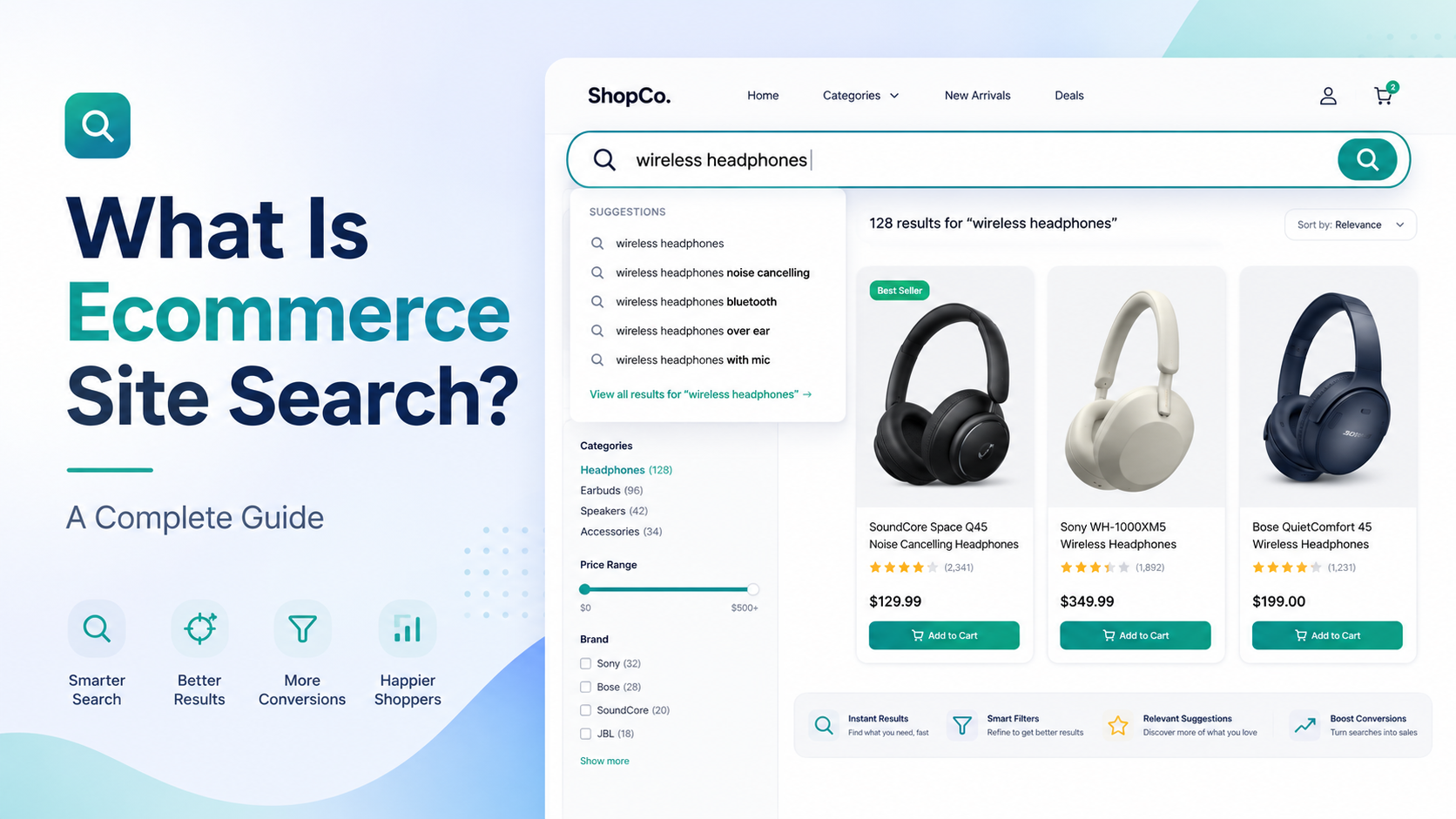
What Is Ecommerce Site Search?
Ecommerce site search is the internal search function that lets visitors type a query into your online store and receive a ranked list of matching products. Unlike Google, which indexes the entire web, your store's ecommerce site search only indexes your own catalogue — products, categories, attributes, and descriptions. When it works well, it acts like a knowledgeable sales assistant who instantly knows where everything is. When it works poorly, it drives customers straight to a competitor.
Understanding what ecommerce site search actually does — and what makes it perform well — is the starting point for any store owner who wants to grow conversion rates.
How On-Site Search Differs from Navigation
Shoppers arrive at your store through two main paths: they browse categories and menus, or they search. Browsing is passive — you present a curated structure and hope it matches the mental model in the shopper's head. Search is active — the shopper tells you, in their own words, exactly what they want.
That directness is the key insight. A shopper who types "waterproof running jacket women size 12" has told you more about their intent in five words than you could infer from watching them click through three levels of navigation. A good search engine uses every part of that query: product type, material attribute, gender, and size variant.
This is why stores with strong site search consistently see higher average order values and lower bounce rates among searchers compared with browsers.
The Components of a Search System
A modern ecommerce search engine has several moving parts working together:
- Index — a pre-built data structure that maps words and attributes to products, so results come back fast rather than scanning every row of your database on every query.
- Query processing — the step where raw user input is cleaned, expanded, and matched against the index. This is where typo tolerance, synonym handling, and AI-powered intent matching happen.
- Ranking algorithm — the logic that decides which matching products appear first. Good ranking weighs text relevance, popularity, stock status, and merchandising rules.
- Results interface — the page the shopper actually sees: product cards, images, prices, filters, sorting options, and pagination.
- Analytics layer — data about what people searched for, what they clicked, and where they gave up, which feeds continuous improvement.
Search Sight packages all of these components into a single hosted service, so you do not need to build or manage them yourself.
Why the Default WooCommerce or Shopify Search Falls Short
Both WooCommerce and Shopify ship with basic search built in. It works at a minimal level — type a word, get some results — but it has well-known limitations:
- No meaningful typo tolerance, so "trainres" returns nothing instead of trainers.
- No synonym awareness, so "sofa" does not return "couch" listings.
- Slow response times, especially on stores with thousands of SKUs.
- No predictive or instant results as the shopper types.
- No insight into what searches fail or why.
For a small store with a handful of products, these limitations are manageable. For any store serious about growth, they become a genuine revenue drag.
What Good Ecommerce Site Search Looks Like
The benchmark for ecommerce site search in 2026 is high. Shoppers have been trained by major retailers to expect results that appear as they type, tolerate spelling mistakes, understand natural-language phrasing, and offer filters to narrow down quickly.
Concretely, a well-implemented search experience delivers:
- Sub-50ms response times so results feel instant, not loaded.
- Typo tolerance that catches common misspellings and phonetic variations.
- Autocomplete and predictive suggestions that surface popular products before the query is finished.
- Faceted filtering on the results page so shoppers can narrow by category, price, colour, size, or any other attribute.
- Synonym support so your product naming conventions do not penalise shoppers who use different vocabulary.
- No-results analytics that tell you when search failed and what to do about it.
For a deeper look at how AI powers modern search, see How AI Ecommerce Search Works. To understand the filtering side, What Is Faceted Search? covers the full picture.
Measuring the Impact of Search on Your Store
If your platform gives you any analytics, the simplest way to understand the value of search is to segment revenue by session type: sessions where the shopper used search versus sessions where they did not.
Across ecommerce as a whole, shoppers who use site search reliably convert at a higher rate and spend more per order. The exact figures vary by sector, but the direction is consistent: search users are your most motivated buyers, and giving them a poor experience is an outsized mistake.
Key metrics to track:
- Search usage rate — what percentage of sessions include at least one search.
- Click-through rate from search results — are shoppers finding what they need on the first try?
- No-results rate — how often does search return nothing? This is the clearest signal of index and synonym gaps.
- Conversion rate segmented by search vs. browse — the headline number that makes the case for investment.
Getting Started with Better Site Search
Switching from a default to a dedicated search solution is typically a one-time setup that takes around five minutes. The practical steps are:
- Sign up and connect your store (for WooCommerce, download the connector plugin; for Shopify, install from the Shopify App Store).
- Your product catalogue syncs automatically to the hosted search index.
- The search widget replaces your existing search bar with an instant-results AJAX interface.
- You tune synonyms, featured products, and redirections from a simple dashboard.
Start your free 14-day trial to see what a properly implemented ecommerce site search looks like on your own store.
Summary
Ecommerce site search is the most direct signal of purchase intent you have. Shoppers who search have already decided they want something — your job is to connect them to it in under a second. Default platform search engines are built to a minimum viable standard; they satisfy the basic requirement but leave significant revenue on the table. A dedicated, AI-powered, sub-50ms search engine does the job your catalogue deserves.