Blog
What Is Product Discovery in Ecommerce?
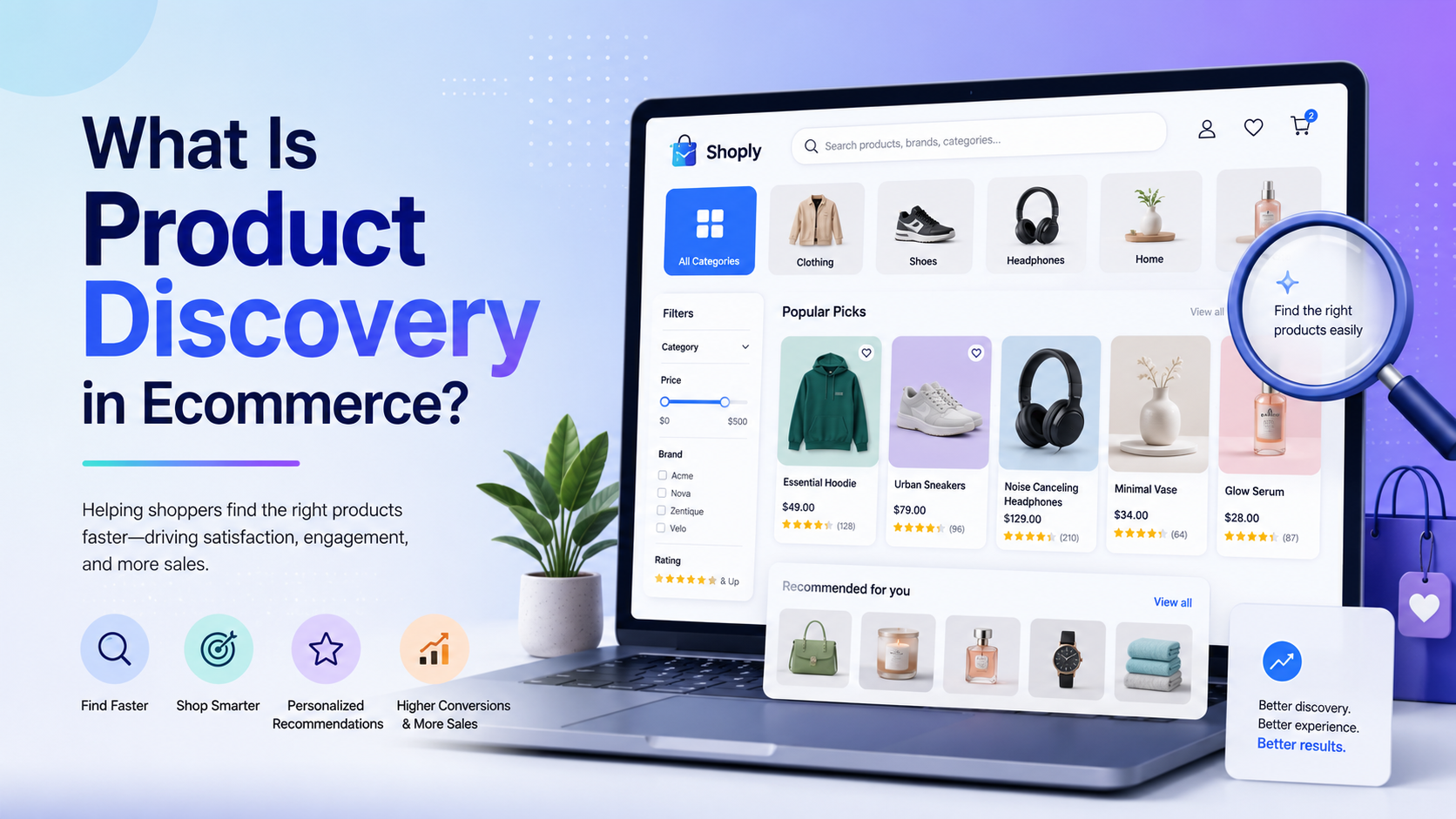
What Is Product Discovery?
Product discovery is the process by which shoppers find products they are interested in buying. It covers every touchpoint between arrival on your store and the moment a shopper adds something to their basket: navigation menus, category pages, on-site search, filters, and any other mechanism that helps someone move from "I arrived at this store" to "I found what I want".
The term is used broadly in ecommerce to describe both the user experience of finding products and the technical infrastructure that powers it. When industry analysts talk about improving product discovery, they typically mean making the path from intent to product shorter, more intuitive, and more likely to surface items the shopper wants — including items they did not know they were looking for.
The Two Paths to Product Discovery
Shoppers discover products through two fundamentally different modes.
Active discovery happens when a shopper arrives with a specific intent and uses search to express it. "I want waterproof ankle boots in a size 6." They type, the engine interprets, and the results page either delivers or fails them. This is the high-stakes mode: the shopper has declared their intent and expects a precise answer.
Passive discovery happens when a shopper browses without a specific product in mind. They navigate through categories, scroll results pages, respond to what catches their eye. This mode is where a well-structured catalogue and strong faceted filtering make a real difference — they help a vaguely motivated shopper narrow down to something they actually want to buy.
Ecommerce stores that perform well at both modes tend to have strong site search and well-built category and filter structures. Neither alone is sufficient.
Why Product Discovery Matters for Revenue
The connection between product discovery and revenue is direct: if a shopper cannot find a product, they cannot buy it. Every friction point in the discovery journey — a search that returns no results, a filter set that does not include the right attribute, a category structure that does not match how shoppers think — is a conversion leak.
Consider a few concrete scenarios:
- A shopper searches for "grey marl hoodie" and your search engine returns nothing because your catalogue uses "charcoal marled sweatshirt". That is a product discovery failure caused by synonym gap.
- A shopper wants to narrow your boot selection to sizes available in stock. If your filter panel does not offer a size filter with in-stock logic, they will scroll through unavailable options and likely leave.
- A shopper wants to spend between £40 and £80 on a gift and cannot find a price range filter. They guess, overshoot, and abandon.
Each of these is fixable, and fixing them has a direct, measurable impact on conversion rate and revenue.
The Role of Search in Product Discovery
On-site search is typically the highest-intent product discovery channel in a store. Shoppers who use the search bar have self-selected as motivated buyers — they know what they want and are trying to get it quickly. This makes search performance disproportionately important: a failure in search is a failure at the moment of highest intent.
A modern AI-powered search engine improves product discovery at every step of the active discovery path:
- It tolerates typos so imprecise typing does not result in empty pages.
- It expands synonyms so different vocabularies reach the same products.
- It surfaces autocomplete suggestions as the shopper types, often completing the path to discovery before the query is even finished.
- It ranks results by relevance and popularity so the most likely match appears first.
For a detailed explanation of how AI powers this, see How AI Ecommerce Search Works.
Faceted Navigation and Passive Discovery
For passive discovery, the filter panel on a search results or category page is often more important than the search engine itself. Faceted navigation lets a shopper who typed "boots" narrow that initial broad result set down to exactly the size, colour, material, and price range they want — all without typing additional queries.
The design of your facet set matters enormously. Useful facets map to how shoppers actually make decisions, not just to how your data is structured. A clothing store should offer size, colour, and material facets. A tool store should offer voltage, brand, and application facets. A jewellery store should offer metal type, gemstone, and price facets.
A well-designed filter panel turns a passive browse session into a guided journey toward purchase. See What Is Faceted Search? for a full guide to designing and implementing faceted navigation.
Predictive Search and Discovery at the Autocomplete Stage
One of the most valuable product discovery moments is the autocomplete stage — when a shopper starts typing and the search engine offers suggestions before the query is complete. Done well, autocomplete can:
- Complete the query faster, reducing the effort required to discover a product.
- Suggest popular products or categories the shopper might not have thought of, acting as a passive discovery engine inside an active search interaction.
- Surface seasonal or featured products that the merchant wants to promote.
This hybrid of active and passive discovery is one of the reasons predictive search has become a standard feature expectation in 2026.
Measuring Product Discovery Performance
To improve product discovery, you need to measure where it is failing. The most important metrics are:
- No-results rate — queries that return nothing. A direct measure of search discovery failure.
- Low-click search sessions — searches where the shopper looked at results but clicked nothing, suggesting poor relevance.
- Bounce rate from category pages — a high bounce suggests the product set or filter options did not match the shopper's intent.
- Conversion rate by discovery path — do search-first sessions convert better than browse-first? This comparison tells you where to invest.
Search Sight provides a no-results analytics report as a standard feature on all plans, giving you a direct line of sight into product discovery failures.
Improving Product Discovery Without a Full Rebuild
The good news is that significant product discovery improvements do not require rebuilding your store. The highest-leverage interventions are:
- Replacing default platform search with an AI-powered, instant search engine.
- Expanding your synonym dictionary to bridge catalogue language with shopper vocabulary.
- Auditing your facet set and adding missing attributes.
- Reviewing your no-results report and acting on the top queries.
Start your free 14-day trial and start improving product discovery on your store today.
For a wider introduction to on-site search, visit the ecommerce search hub.